
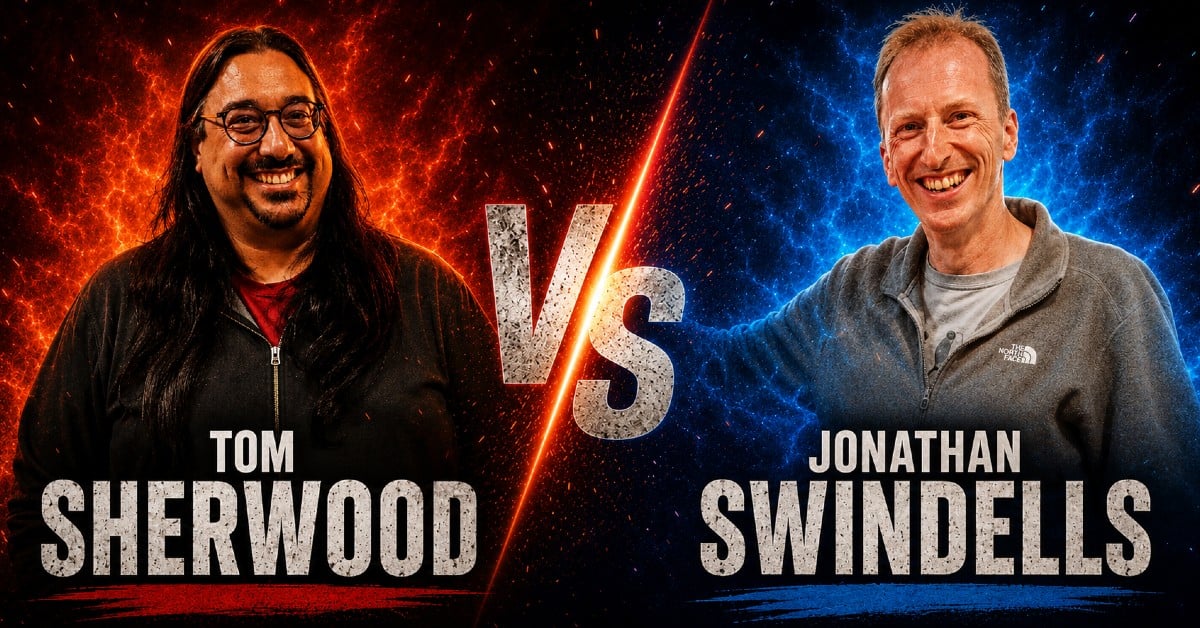
Each year in recent memory, the membership of Longbridge Chess Club has the privilege of having their collective behinds handed to them by Jon Swindells in a simultaneous display. Jon is an exceptionally strong player, graded a lofty 2251, and this year took on 23 members in a gruelling 4 hour long tour-de-force.
Jon secured 19 wins, and conceded 3 hard-fought draws to Gary Mason, Nam Anh Nguyen, and Stephen Woodhouse. The arithmetically minded reader may notice one board unaccounted for, however, and this was the evening’s only fly in the ointment for Jon, but an exciting victory for Tom Sherwood (me!) in a game characterised by opposition research, opening prep, and both seized and missed opportunities alike!
Here’s a brief look at some of the key phases and critical turning points of what ended up being quite an interesting game!
Here’s the game, so you can jump to positions discussed below…
Preparation & The Plan
Weeks before the simul, Tom and Jon had been chatting about openings following a home fixture, during which Tom mentioned he was considering playing Black in the upcoming simul after having been crushed playing White last year. Hearing that Jon was predominantly an e4 player with the White pieces, Tom remarked that they might play a Sicilian this time. Jon, knowing that Tom favoured the Najdorf Sicilian, kindly warned him that he would play a Closed Sicilian, specifically a Grand Prix Attack. Since the Najdorf can only be played in response to the Open Sicilian, Tom had some homework to do!
Unfortunately, Tom is hardly the best student, and so the hour before the simul found him cram-prepping a 20 minute YouTube video on how to play against the Grand Prix Attack and memorising a couple of key opening lines and concepts!
Out of Prep Early
The first few moves of the game progressed as expected allowing Tom to establish his core setup with a knight on c6 and a kingside fianchetto. While Tom was anticipating either 5. Bc4 or 5. Bb5, and had an increasingly hazy memory of the correct responses and ideas, Jon instead played 5. a4 taking Tom out of his hasty prep and highlighting the limits of his knowledge. With a key idea of harassing White’s light-squared bishop with a queenside pawn advance severely hampered, Tom was forced to improvise and fall back on his understanding of other key themes within this opening battle.
Early Progress Stalled
As the game progressed and development continued, a questionable exchange of knights gave Tom an early advantage temporarily pushing Jon’s other knight backwards into passivity.
With the position becoming more congested and development mostly complete, Tom elected to break open the position with 15. … f6 to try to make progress.
Jon’s Domination & Tom’s “Hail Mary” Escape
After Tom’s pawn break, Jon steadily outplayed Tom, seemingly inevitably gaining the upper hand until he was able to engineer a position where he was winning a piece!
Tom, seeing that he was imminently going to be down a piece, was in serious trouble! Resigned to the fact that the knight was lost anyway, he felt his best option was to complicate things with a flawed “Hail Mary” escape idea. Tom played 24. … Nf3+ reasoning that if Jon played the very natural 25. gxf3, Tom could trade rooks on e1 with 25. … Rxe1+, diverting the queen from the defence of the f4 bishop allowing Tom to win the piece back!
So, what was the flaw? Well, Jon didn’t have to capture with 25. gxf3 and instead could simply play 25. Kf2 and Tom would have to save his hanging queen, giving White time to pick up the free knight! Thankfully, due to the number of games and Nam keeping Jon under pressure on another board, Jon overlooked that his bishop would hang at the end of the sequence and was forced to settle for winning the d5 pawn with check. After 27. Bxd5+ the position was as follows with Black continuing with 27. … Kf8.
The Turning Point, White’s Decisive Mistake
Salvation came suddenly and unexpectedly for Black, just a couple of moves later when Jon blundered with 28. Kg2?? allowing 28. … Qg5+ picking up the bishop!
This proved to be the decisive error and from here, the evaluation swung sharply in Black’s favour.
As Jonathan later explained, the move was the result of overthinking king safety concerns and missing a loose piece in the position.
Missed Opportunities
Even after gaining the advantage, Tom did not immediately convert cleanly.
At move 44, he played 44. … Bd7 missing a direct winning continuation with 44. …Qe3+ and whichever way White’s king goes, there’s a forced checkmate! If 45. Kh2, Black has 45. … Qf2#, similarly if 45. Kh4, then 45. … Qxf4#. Meanwhile if White instead flees with 45. Kg4 Black has 45. … Qf3+ and after 46. Kg5 Qh5# the game is again over!
Worse, this wasn’t the only winning idea Tom missed! A move later, Tom missed the devastating 45. … Qe1+ which would have won Jon’s queen for free!
Instead, the game continued with complexity still on the board, and precision was still required to finish the job. When asked about the oversights, predictably Tom sheepishly pointed to the time pressure, as with most of the other players defeated already, Jon was making his rounds of the room pretty quickly limiting the available thinking time!
Perseverance
With Tom having missed his big chances to end the game decisively the battle continued for another six or so moves each with Jon fighting hard to prevent Tom making any progress, and doing all he could to provoke a draw by repetition situation or a mistake, and get himself back into the game. Despite a few missteps, Tom was eventually able to manoeuvre so as to get his queen controlling the open e-file and then grab Jon’s c-pawn whilst maintaining the initiative through checks.
Jon was a constant danger with his tricky queen play, so when Tom saw an opportunity to force an exchange of queens leaving him a bishop up in an endgame with pawns on both sides of the board, he took it! Seeing that the endgame was almost certainly lost, Jon was forced to concede defeat, resigning and giving Tom the club’s only win from the last two years of Jon’s simuls!
This was the final position of the game:
Jonathan Swindells’ reflections
After reviewing the game, Jonathan Swindells shared his thoughts on the key moments.
He highlighted the tactical turning point around 24. … Nf3+, noting that he had not fully anticipated the resulting complications when committing to earlier pressure ideas involving pins on the f-file.
He also admitted that in the critical moment at move 28:
“The fatal Kg2 was born out of sudden concerns for king safety… I overthought it and forgot about the loose piece, which did what loose pieces do (drop off).”
Jonathan added that time pressure and the sheer volume of games in the simul played a significant role in his decision-making.
Despite the loss, he was complimentary about Tom’s handling of the complications:
“You did everything right from Nf3+ onwards. That complicated the game and you took your chance when it came. You definitely earned the full point.”
Summary
Whilst tactical shots may have decided the game, various factors had a huge impact for both players:
- Early deviation from preparation
- Stagnation and an attempt to make progress
- The creative but flawed “hail Mary” 24. …Nf3+
- Jonathan’s decisive blunder on move 28
- Embarrassing missed wins by Tom
- Accurate endgame play and perseverance to secure the win
In the end, Tom Sherwood’s ability to navigate the complexity under pressure secured the only defeat of the evening for the simul host.
If you would like to explore a deeper analysis of the game with Tom’s full thoughts and comments, please feel free to check out the game here.
Final Score
- Jonathan Swindells: 19 wins
- Draws: 3 (Gary Mason, Nam Anh Nguyen, Stephen Woodhouse)
- Tom Sherwood: 1 win

That’s awesome
It was such a fun night
Well done Tom on your win
And well done Jon for an amazing performance