
Chess notation can be intimidating for players who haven’t used it before. One of the most common questions we hear from new members at Longbridge Chess Club is:
“I’d love to play in matches, but I don’t know how to write notation.”
The good news is that chess notation is much easier than it looks.
If you’ve only ever played friendly games, online chess, or casual games with family and friends, the idea of recording every move can seem a little intimidating. However, after a game or two, most players find it becomes second nature.
This guide will explain everything you need to know before playing your first league match.
Why Do Players Record Their Moves?
In most league and tournament games, players are expected to record their moves on a scoresheet.
There are several reasons for this:
- It creates an official record of the game.
- It helps resolve disputes if a problem occurs.
- It allows players to analyse their games afterwards.
- It can be used to reconstruct positions if needed.
Don’t worry about making your scoresheet perfect. Every experienced player started exactly where you are now.
You Don’t Need to Write Every Piece of Information
Many new players imagine they need to write long descriptions such as:
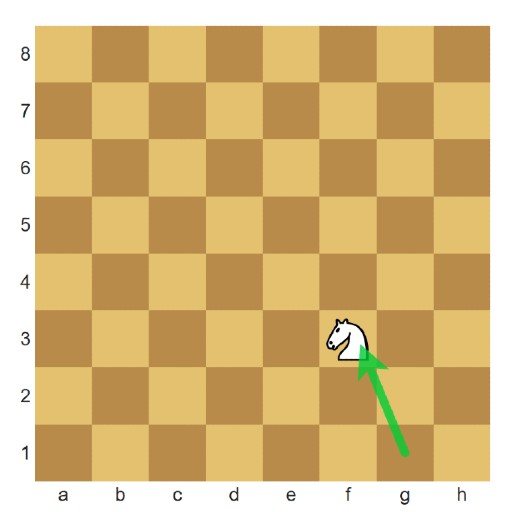
“Knight moves from g1 to f3.”
Thankfully, that’s not how notation works. Instead, chess uses a simple shorthand system.
For example, the move in the image here, would be displayed as:
- Nf3
Each move only takes a second or two to write down.
Understanding the Board
First off, you need to understand that each square on the chessboard has coordinates.
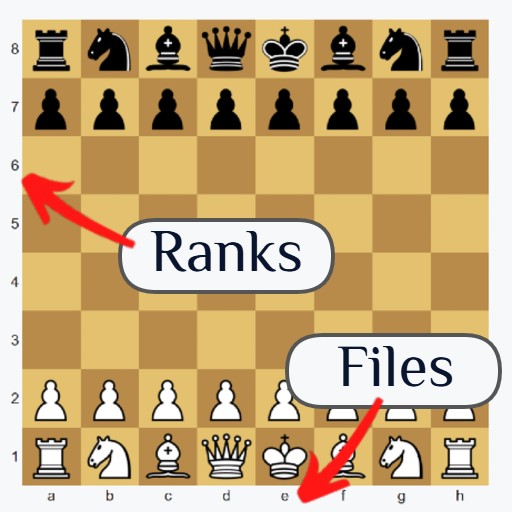
The horizontal columns, known as files, are labelled:
a, b, c, d, e, f, g, h
The vertical rows, known as ranks, are numbered:
1, 2, 3, 4, 5, 6, 7, 8
This means every square can be identified easily.
For example:
- e4
- c6
- h7
Once you know the square names, you’re halfway to understanding notation. Bear in mind, when playing white, the “a” file will be on your left hand side, when playing black, it will be on your right.
Alternatively, when playing white, the rank closest to you will be 1, and furthest from you will be 8. When playing black, the closest rank to you will be 8, and the furthest is 1.
How the Pieces Are Written in Chess Notation
Each chess piece can be displayed as a letter:
| Piece | Letter |
|---|---|
| King | K |
| Queen | Q |
| Rook | R |
| Bishop | B |
| Knight | N |
| Pawn | No letter |
The Knight uses N because K is already used for the King. When writing notation, these letters are always capitalised.
Some Common Examples
- Pawn Move, If a pawn moves to e4, simply write: e4
- Knight Move, If a knight moves to f3, write: Nf3
- Bishop Move, If a bishop moves to b5, write: Bb5
That’s it. Write the piece letter (always capitals!), followed by the square it moves to. It is that simple. Most chess boards will have the letters and numbers on the board to help you know what square the piece has moved to.
What About Captures?
If a piece moves to a square, but at the same time it captures a piece, you simply add an x.
Examples:
- Nxe5 (Knight captures on e5)
- Bxc6 (Bishop captures on c6)
- Qxh7 (Queen captures on h7)
The x simply means captures. Pawn captures work slightly differently though because they do not have a letter.
For example:
exd5
This means the pawn from the e-file captures a piece on d5. So you just write essentially, the e pawn, captures on this specific square. Nice and simple.
Castling
Castling works a little differently, and has its own notation. You can castle in two different ways, king side, or queen side. Because of this, there are two different ways to write castling in chess notation.
O-O = Kingside castling
O-O-O = Queenside castling
These are capital letter O’s, not zeroes.
Check and Checkmate
Now you should have a good understanding about how to write the basics of chess notation. You will be able to write down where a piece moves, and what it captures.
Now, if your move puts your opponent’s king in check, all you have to do is add a + symbol.
Examples:
- Qh5+ (Queen moves to h5 and checks the king)
- Bb5+ (Bishop moves to b5 and checks the king)
- Re8+ (Rook moves to e8 and checks the king)
If your move delivers checkmate, instead of check, just add a # symbol instead of +.
Examples:
- Qh7# (Queen moves to h7 and checkmates the king)
- Re8# (Rook moves to e8 and checkmates the king)
Don’t worry if you occasionally forget these symbols when you’re starting out. Most players do at some point.
Pawn Promotion
If a pawn reaches the final rank, it must be promoted. It can be promoted to any piece, and this can be written down simply by writing which file the pawn is on, then an = sign, and the piece it gets promoted to.
Examples:
- e8=Q (The e pawn promotes to a Queen)
- c1=N (The c pawn promotes to a Knight)
Most promotions are to a Queen, but notation allows for any legal promotion.
When Two Pieces Can Move to the Same Square
Sometimes two identical pieces can both move to the same square. This will happen with knights and rooks.
For example, imagine both of your knights can take on e5:
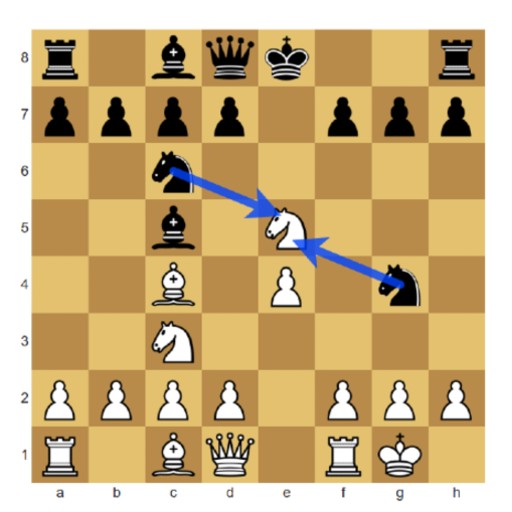
Writing: Nxe5, would not tell us which knight moved.
To solve this, notation adds extra information.
Examples:
- Ngxe5 = The knight from the g file takes e5.
- Ncxe5 = The knight from the c file takes on e5.
This is the same principle for rooks too. Occasionally, the rank is used instead.
Examples:
- R1e3
- R8e3
This simply removes any ambiguity about which piece moved.
Combining Notation
Sometimes several notation rules appear in the same move.
For example: Qxh7+
This means:
- Queen captures on h7
- The move gives check
Another example: Rxe8#
This means:
- Rook captures on e8
- The move gives checkmate
Although these moves look complicated, they are simply several notation rules combined together.
En Passant
En passant is recorded exactly like a normal pawn capture.
For example: exd6
Nothing special is added to the notation.
Recording a Real Game
In a real match, you record both your moves and your opponent’s.
Imagine you’re playing White and the game begins:
- e4 e5
- Nf3 Nc6
- Bb5
This means:
- You played e4.
- Your opponent replied with e5.
- You played Nf3.
- Your opponent replied with Nc6.
- You played Bb5.
- It is your opponents move
After Black makes their next move, you would record that too.
The scoresheet grows move by move until the game finishes.
What If I Make a Mistake?
Don’t panic. Every club player has made mistakes on a scoresheet at some point. If you write something incorrectly, simply correct it neatly and continue.
If you miss a move, you can often compare scoresheets with your opponent later and fill in the missing information. The aim is to keep an accurate record of the game, not produce a perfect document.
Chess Notation Cheat Sheet
| Meaning | Notation |
| Pawn to e4 | e4 |
| Knight to f3 | Nf3 |
| Bishop captures e5 | Bxe5 |
| Pawn captures d5 from e-file | exd5 |
| Kingside castling | O-O |
| Queenside castling | O-O-O |
| Check | + |
| Checkmate | # |
| Promotion to Queen | =Q |
| Rook from a-file to e8 | Rae8 |
| Queen captures on h7 and checks | Qxh7+ |
Why It’s Worth Learning
Once you start recording your games, you’ll discover one of the biggest benefits of league chess.
You can go home afterwards and analyse your games! Many players improve more from reviewing their own mistakes than from studying openings or watching videos.
Without notation, that opportunity is lost.
Ready to Play for Longbridge?
Don’t let notation put you off playing in matches. Every player who has ever represented Longbridge Chess Club had to learn it at some point, and most picked it up very quickly.
If you’re unsure about anything before your first match, just ask one of our experienced members. We will be happy to help. You will even be able to play a friendly game, and take notation if you want to as practise before your first big game! Just ask.
The most important thing is getting involved, enjoying your chess, and taking the first step into competitive play.
1 thought on “How to Read and Write Chess Notation: A Beginner’s Guide”