
In this chess lesson we are going to cover chess opening principles. The opening is the first stage of a chess game, and it is one of the most important parts to understand. A good opening gives your pieces room to move, helps you control the board and prepares you for the middlegame.
For beginners, the opening can sometimes feel confusing. There are hundreds of different openings, countless variations and plenty of advice about which moves you should play.
But here’s the good news: you don’t need to memorise dozens of opening lines to play a good opening.
By understanding a handful of basic chess opening principles, you can give yourself a much better chance of reaching a strong position, even when you’re playing an opening you’ve never seen before.
1. Control the Centre
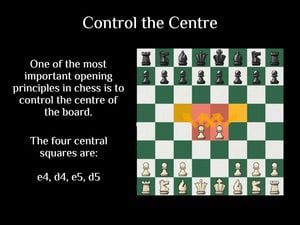
One of the most important chess opening principles is to control the centre of the board.
The four central squares are:
- e4
- d4
- e5
- d5
Why are these squares so important?
Because pieces placed towards the centre generally have more influence over the board. They can move in more directions, attack more squares and influence both sides of the position.
Imagine trying to control a battlefield. You wouldn’t want all your forces stuck in the corners. You want to occupy important ground and give your pieces room to operate.
Chess is no different.
A common way to fight for the centre is by moving your central pawns, particularly the e-pawn and d-pawn.
For White, moves such as 1.e4 and 1.d4 are excellent ways to fight for central control.
For Black, moves such as …e5, …d5, …c5 and …Nf6 help challenge White’s influence.
Remember, controlling the centre doesn’t always mean occupying all four squares with pawns. You can also control central squares with your knights, bishops and other pieces.
The key lesson: Fight for the centre and give your pieces room to become active.
2. Develop Your Pieces
Another fundamental chess opening principle is to develop your pieces.
Development simply means moving your pieces from their starting squares to more active positions where they can influence the game.
At the beginning of a chess game, your knights and bishops are blocked in by your own pawns. They aren’t doing very much!
Your job is to get them into the game.
For White, common developing moves include:
- Nf3 – Developing the kingside knight.
- Nc3 – Developing the queenside knight.
- Bc4 – Developing the kingside bishop.
- Bf4 – Developing the queenside bishop.
Black has similar developing opportunities.
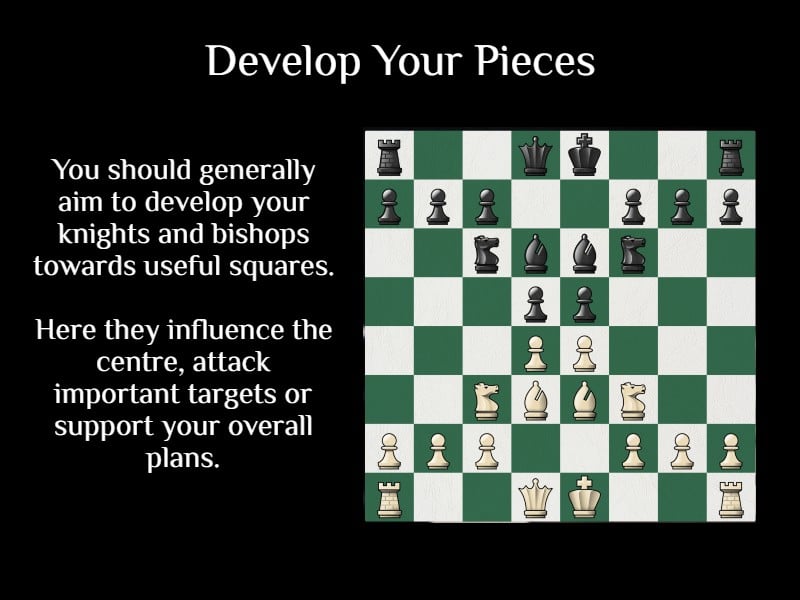
You should generally aim to develop your knights and bishops towards useful squares, where they influence the centre, attack important targets or support your overall plans.
A useful general guideline is to develop your knights and bishops before moving your queen and rooks.
Don’t worry about finding the perfect square for every piece immediately. Getting your pieces off their starting squares and into the game is a very good start.
The key lesson: Get your knights and bishops developed so they can take part in the game.
3. Develop With a Purpose for Good Chess Opening Principles
Developing your pieces is important, but simply moving them somewhere isn’t enough.
You should always try to develop your pieces to useful squares.
For example, a knight on f3 controls important central squares, including e5 and d4. It also helps prepare kingside castling.
A knight moved to the edge of the board, such as a3, generally has less influence.
This doesn’t mean that a knight on a3 is always a bad move. There are positions where it has a perfectly good purpose. But as a general principle, you want your pieces to occupy active squares.
When deciding where to develop a piece, ask yourself:
- Does this square help me control the centre?
- Does it attack anything?
- Does it defend anything important?
- Does it help prepare for castling?
- Does it improve my position?
Try to make every developing move serve a purpose.
The key lesson: Don’t just develop your pieces. Develop them to useful squares.
4. Castle Early and Keep Your King Safe
Your king is the most important piece on the board. If your king is checkmated, the game is over.
During the opening, the centre of the board can become very dangerous as pawns move and lines open up.
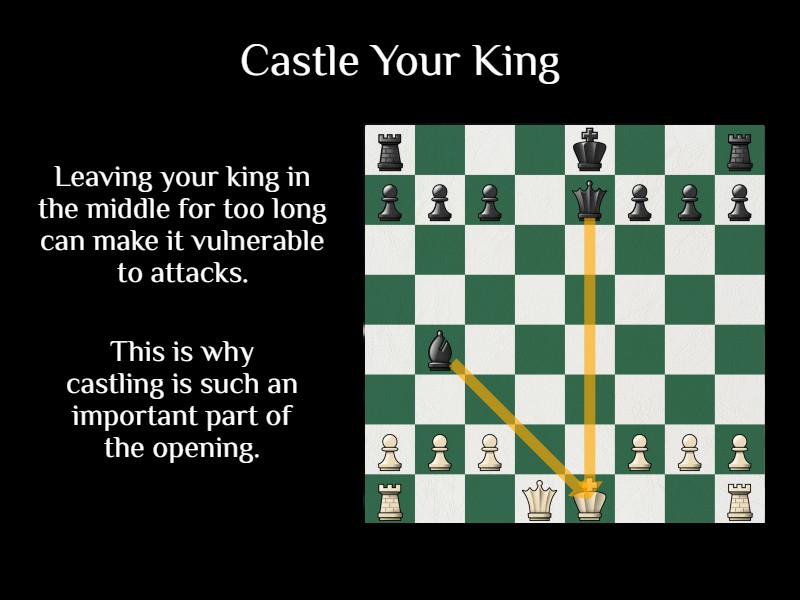
Leaving your king in the middle for too long can make it vulnerable to attacks.
This is why castling is such an important part of the opening.
Castling allows you to move your king towards the corner of the board while bringing your rook closer to the centre.
There are two types of castling:
- Kingside castling (O-O).
- Queenside castling (O-O-O).
For beginners, kingside castling is often the simpler and more common choice.
Castling also helps connect your rooks, which we’ll discuss later.
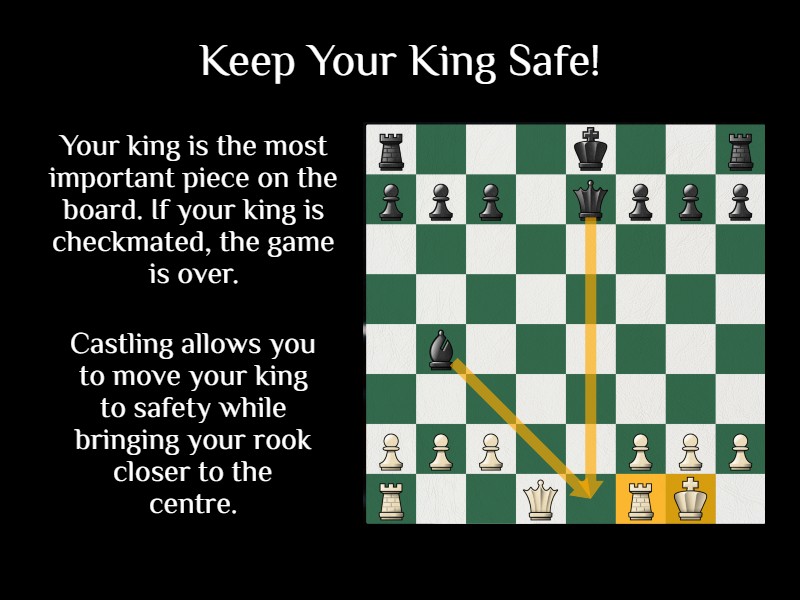
As a general rule, try to castle within the first 10 moves if the position allows it.
However, don’t castle automatically. Sometimes there is a good reason to delay castling, particularly if your opponent has created a threat or the position makes castling unsafe.
Remember that you can only castle if:
- Your king hasn’t moved.
- The relevant rook hasn’t moved.
- There are no pieces between your king and rook.
- Your king isn’t currently in check.
- Your king doesn’t move through or land on an attacked square.
The key lesson: Get your king to safety and don’t leave it sitting in the centre unnecessarily.
5. Don’t Move the Same Piece Repeatedly
A common mistake among beginners is moving the same piece several times during the opening.
For example, you might develop your knight, move it again to another square, and then move it a third time without a particularly good reason.
The problem is that every move in chess is valuable.
While you’re moving the same piece repeatedly, your opponent could be developing their knights and bishops, controlling the centre and preparing to castle.
They are getting more pieces into the game while you’re spending moves repositioning something that was already developed.
This is known as losing time, or losing a tempo.
Of course, there are times when moving the same piece twice is perfectly correct.
You might need to retreat from an attack, capture something important or take advantage of a tactical opportunity.
The important thing is to avoid wasting moves.
The key lesson: Try to develop a new piece with each move rather than repeatedly moving pieces that are already developed.
6. Don’t Bring Your Queen Out Too Early
Your queen is the most powerful piece in chess. She can move in almost every direction and is capable of creating serious threats.
However, this also makes her a target.
One of the most common beginner mistakes is bringing the queen out too early in an attempt to attack the opponent.
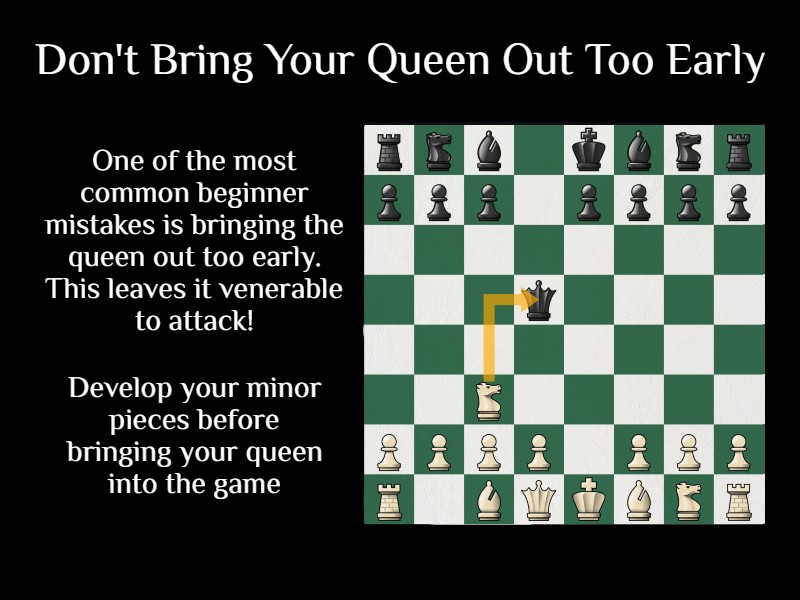
The problem is that your opponent can often develop their pieces while attacking your queen at the same time.
This means you have to move your queen again, while your opponent has improved their position.
For example, imagine you bring your queen out to attack a pawn. Your opponent develops a knight with a threat against your queen.
You now have to spend another move moving the queen to safety.
Your opponent has gained a useful developing move, while you have effectively wasted a move with your queen.
This doesn’t mean you should never bring your queen out early. There are plenty of openings where an early queen move is perfectly sound.
But for beginners, it’s generally better to develop your knights and bishops first.
The key lesson: Don’t expose your queen unnecessarily. Develop your minor pieces before bringing your queen into the game.
7. Don’t Make Unnecessary Pawn Moves
Pawns are the smallest pieces on the board, but they play a very important role in the opening.
They help control the centre, create space for your pieces and protect important squares.
However, every pawn move changes the structure of your position.
Unlike your other pieces, pawns cannot move backwards. Once you’ve moved a pawn, you cannot simply put it back where it was.
Moving too many pawns during the opening can create weaknesses and leave your pieces undeveloped.
For example, imagine spending several moves pushing your pawns on the kingside while your knights and bishops are still sitting on their starting squares.
Your opponent could use that time to develop their pieces and prepare an attack.
You should generally focus on moving your central pawns and making the necessary pawn moves to develop your pieces.
Be particularly careful about moving the pawns in front of your king unnecessarily. These pawns help protect your king, and moving them can create weaknesses that your opponent may exploit later.
There is nothing wrong with making pawn moves. In fact, they are essential. The important thing is to make them for a reason.
The key lesson: Don’t push pawns just because you can. Make pawn moves that help your development, control the centre or improve your position.
8. Don’t Grab Material at the Expense of Development
Winning a pawn or capturing a piece is usually a good thing, but not if it comes at the expense of your entire position.
One of the most important things to understand in chess is that material isn’t everything.
Imagine your opponent leaves a pawn undefended during the opening.
You might be tempted to send your queen or another piece on a long journey to capture it.
But while you’re busy collecting that pawn, your opponent could be developing their pieces, attacking your queen and preparing a dangerous attack.
You might end up with an extra pawn but a terrible position.
In chess, development, king safety and activity are all extremely important.
Sometimes sacrificing a pawn to gain time, open lines or develop your pieces is the correct decision.
This is particularly important when playing against gambits, where your opponent deliberately offers material in exchange for an advantage in development or attacking chances.
Before grabbing material, ask yourself:
- Is the material actually safe to capture?
- Will my piece become trapped?
- Will I lose time moving the piece again?
- What can my opponent do while I’m collecting it?
The key lesson: Don’t automatically take every pawn or piece your opponent offers. Consider what it will cost you.
9. Connect Your Rooks
Once you’ve developed your knights and bishops, you should move your queen, and castle. This connects your rooks.
At the beginning of the game, your rooks are separated by your king, queen and other pieces.
When you have developed your pieces and moved your king to safety, you should aim to clear the back rank so that your rooks can see each other.
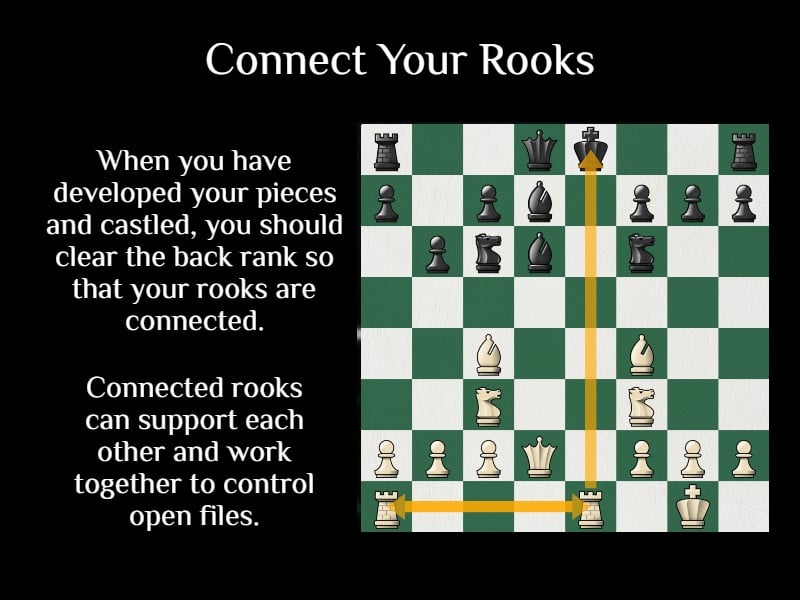
Connected rooks can support each other and work together to control open files.
An open file is a vertical column on the chessboard without any pawns blocking it.
Rooks are particularly powerful on open files because they can travel up and down the board and put pressure on your opponent’s position.
Connecting your rooks is a useful indication that you’ve completed the basic development stage of the opening.
It doesn’t mean the opening is automatically finished, but it does mean you’re generally ready to start thinking more seriously about middlegame plans.
The key lesson: Develop your pieces, castle and clear the back rank so your rooks can work together.
10. What Do Good Chess Opening Principles Look Like?
We’ve covered the individual principles, but what are we actually trying to achieve?
A good opening position generally has the following characteristics:
- Your central pawns are helping you fight for control of the centre.
- Your knights and bishops have been developed onto useful squares.
- Your king is safely castled.
- Your queen hasn’t been exposed unnecessarily.
- You haven’t wasted too many moves moving the same pieces.
- Your pawns aren’t creating unnecessary weaknesses.
- Your rooks are ready to become active.
You don’t need to achieve every single one of these things in every game.
Your opponent will be trying to stop you, and sometimes you will need to respond to threats or change your plans.
But these principles give you a good starting point.
Once you’ve developed your pieces and secured your king, you can start looking for middlegame plans, attacking opportunities and weaknesses in your opponent’s position.
Your Chess Opening Principles Checklist
Before you finish your opening and move into the middlegame, ask yourself these questions:
- Am I fighting for control of the centre?
- Have I developed my knights and bishops?
- Are my pieces on useful squares?
- Is my king safe?
- Have I avoided moving the same piece unnecessarily?
- Have I avoided bringing my queen out too early?
- Have I avoided unnecessary pawn moves?
- Have I avoided grabbing material at the expense of development?
- Are my rooks connected and ready to become active?
You won’t always be able to answer yes to every question, but they are useful things to consider when evaluating your opening position.
Final Thoughts on Chess Opening Principles
Learning opening principles is far more valuable than memorising a long list of opening moves when you’re starting out.
You don’t need to know 20 moves of the Italian Game or memorise every variation of the Sicilian Defence to play a sensible opening.
Instead, focus on controlling the centre, developing your pieces, keeping your king safe and making every move count.
As you improve, you’ll begin to understand why certain openings work, why some moves are stronger than others and when it makes sense to break the usual principles.
Remember: a good opening isn’t about making lots of attacking moves. It’s about building a strong position that gives you the best possible chance of winning the game.
Good luck in your games!